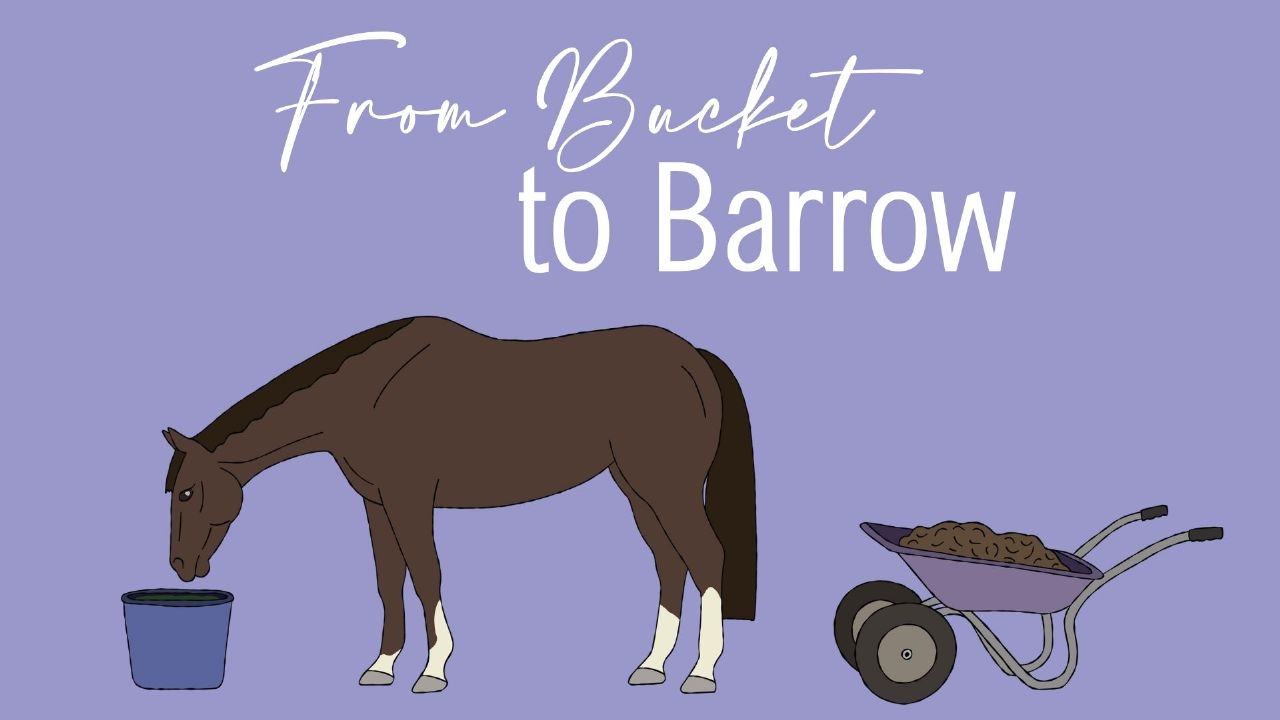
We talk a lot about what goes into the feed bucket. But how often do we think about what happens next?
From the very first chew to the final barrow load, your horse’s digestive system is a finely tuned, forage-fuelled machine. When we understand how it works, our feeding decisions become much clearer - and often much simpler.
Let’s walk through the journey from bucket to barrow...
________________________________________________________
Part One: Digestion Starts in the Mouth
For a horse to chew efficiently, the grinding surfaces of the teeth must align correctly. When grazing with the head down, the lower jaw naturally slides slightly forward. In a well-conformed mouth, this allows even tooth wear and efficient breakdown of forage.
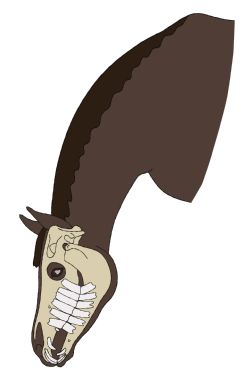
But here’s the crucial point: The horse has muscles to retract the lower jaw - but not to move it forward.
When we feed from raised haynets or buckets positioned high off the ground, the head lifts. The lower jaw slips back. The teeth no longer align properly.
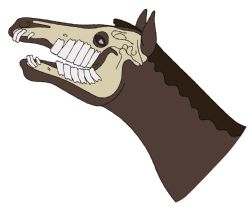
Over time, this contributes to the sharp enamel points we so commonly see:
- Sharp edges on the outside of the upper teeth
- Sharp edges on the inside of the lower teeth
- Hooks at the front of the upper arcade
- Ramps at the back to the lower arcade
________________________________________________________
Part Two: Chewing = Saliva = Protection
While chewing, the horse produces saliva - and a lot of it.
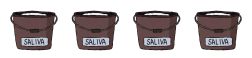
A naturally grazing horse chews for around 16 hours per day. During that time, they produce between 36 and 42 litres of saliva - enough to fill four 10-litre / 2 gallon buckets.
Unlike our salia, equine saliva contains very few digestive enzymes. That’s because the horse’s natural forage diet is low in sugar, starches and fats. Nature is efficient; it doesn’t produce what isn’t needed.
Instead, equine saliva has two key roles:
- Lubricating coarse forage
- Neutralising stomach acid (thanks to its high bicarbonate content)
There’s one vital point to remember: Horses only produce saliva when they chew.
If chew time decreases, saliva decreases - but stomach acid production does not.
________________________________________________________
Part Three: From Bolus to Oesophagus
A horse with healthy teeth chews feed down to particles of around 2mm before swallowing.
The food is formed into moist boluses, mixed thoroughly with saliva. An average 500kg horse swallows roughly 500g at a time - you can often see the bulge pass down the neck.
With the head down, the oesophagus forms a smooth curve to the stomach.
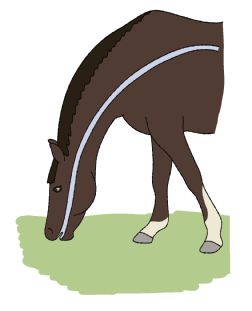
When the head is raised, bends are introduced at the throat and where the oesophagus enters the chest - increasing resistance and potentially affecting swallowing efficiency.
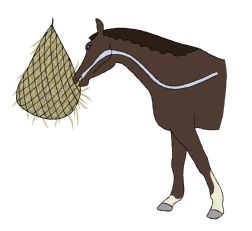
Another reason why the natural ‘head-down’ eating position matters.
________________________________________________________
Part Four: The Small but Mighty Stomach
Despite the horse’s size, the stomach holds only around 5 litres.
Why so small? Evolution.
A small stomach that empties frequently leaves more room for heart and lungs - essential for rapid escape from predators.
Here’s the management challenge: The stomach produces acid continuously (around 40 litres / 4 10L buckets, per day).
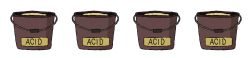
Saliva, which buffers acid, is only produced when chewing. When we feed small, calorie-dense meals that require minimal chewing, horses receive energy - but not enough saliva to neutralise the acid. Excess acid can damage the stomach lining, contributing to gastric ulcers. It may also pass further along the tract, affecting the hindgut.
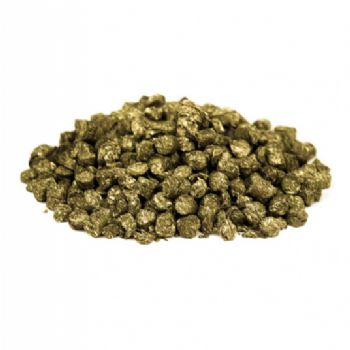
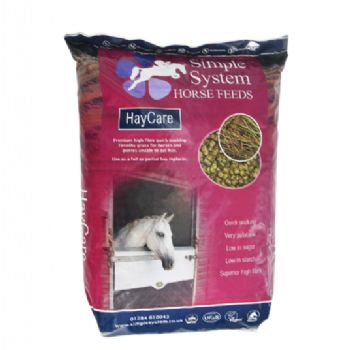
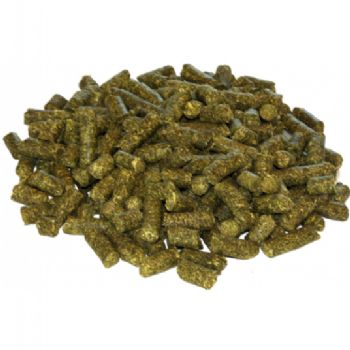
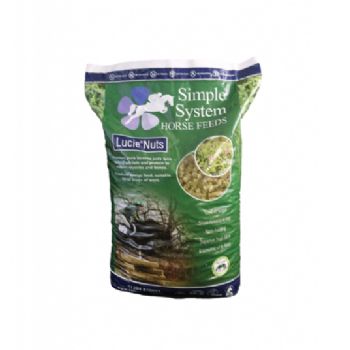
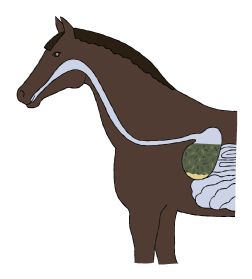
When a horse is eating forage - grass, hay or soaked forage feeds like Lucie Nuts or HayCare - the stomach never becomes overfull. It maintains a steady level and empties small amounts frequently. This steady trickle is what the system evolved to handle.
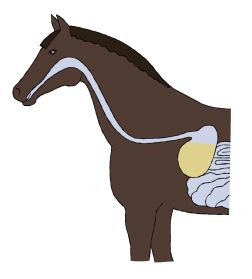
Long periods without forage leave acid sloshing in an empty stomach - particularly problematic during exercise.
________________________________________________________
Part Five: The Small Intestine: Rapid Transit
From the stomach, feed moves into the small intestine which is around 20 metres long, yet relatively short compared to other herbivores.
First it enters the duodenum, then the jejunum and finally the illeum. Here:
- Bile (around 20 litres per day) is added
- Pancreatic fluids (around 35 litres per day) are introduced
- Digestible nutrients are absorbed
Altogether, the horse produces roughly 130 litres of digestive fluids every 24 hours. Much of this is efficiently recycled.
To move safely through the small intestine’s twists and turns, feed must now be 90-95% liquid. This is another reason adequate hydration and saliva production matter.
If a horse has been without forage for an extended period, bile can backflow towards the stomach, irritating the pyloric region and potentially contributing to pyloric ulcers.
________________________________________________________
Part Six: The Hindgut: The Fermentation Vat
Once feed leaves the small intestine, it enters the hindgut - beginning with the caecum.
The caecum is a large fermentation chamber holding 25-35 litres. Here live trillions of microbes: bacteria, fungi and yeasts.

These microbes:
- Break down fibre
- Produce free fatty acids (slow-release energy for stamina)
- Manufacture B-group vitamins and vitamin K
- Generate heat (supporting thermoregulation)
- Produce gas (a normal by-product of fermentation)
This is where the horse truly derives value from forage.
The free fatty acids (FFA’s) produced here fuel the horse’s slow-burn energy pathways - ideal for endurance and steady or sustained work.
________________________________________________________
Part Seven: Movement Matters
In the small intestine, strong muscular contractions (peristalsis) push food along.
In the hindgut, the system is much larger and relies more on continuous intake to keep contents moving forward. If a horse stops eating or drinking for prolonged periods, contents can dry out and compact - increasing the risk of impaction colic.
Put simply: If the horse keeps eating, the gut keeps moving.
________________________________________________________
Part Eight: The Small Colon, Large Colon and Warning Signs
The large colon occupies much of the right-hand side of the abdomen, looping and doubling back on itself.
Hindgut disturbances are difficult to diagnose directly.
Signs may include:
- Girthiness
- Right-sided discomfort
- Reluctance to strike off on the right canter lead
- Loose droppings or free faecal water
Hindgut ulcers and acidosis are more common than many realise.
As water is gradually reabsorbed, contents move into the small colon, where familiar faecal balls are formed.
And finally - the barrow.
________________________________________________________
A brief overview
From bucket to barrow, everything comes back to one central theme:
The horse is designed to:
- Chew for long periods
- Consume a forage diet
- Maintain continuous digestive flow
When we feed in a way that respects that design - floor level feeding, high forage intake, appropriate chew time - the system works remarkably well.
When we restrict forage intake, we begin to work against their evolutionary design.
The digestive system isn’t complicated, it is simply specialised. Feed for the system your horse has.
________________________________________________________
Looking for horse feed advice?
The Feed Line nutritionists at Simple System Horse Feeds offer free, friendly advice. Contact the Feed Line on 01728 604 008, email info@simplesystem.co.uk or request a Feed Plan by filling out the online advice request form.
________________________________________________________